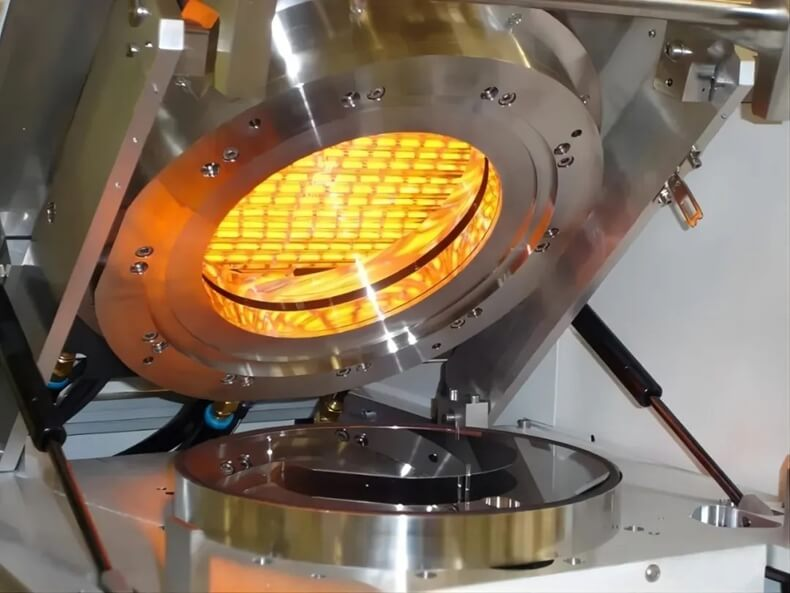
On the packaging floor, heat is never just heat. It’s a controlled lever in the yield game. A single cold spot on the wafer during drying, one overshoot during photoresist soft bake, and you’ve just handed the defect budget to the other guy. In advanced packaging—stacked dies, fine-pitch RDLs, thin encapsulants—there’s no room for drift. Infrared lamp systems have to deliver thermal behavior that stays inside the process window, cycle after cycle. We built our advanced packaging infrared lamp for those exact moments: when the recipe needs fast, uniform temperature; when cleanroom particle control is table stakes; and when uptime depends on parts that behave predictably, shift after shift.
What actually matters under the hood
Infrared only earns its keep when it’s measurable, repeatable, and stable right at the wafer plane. We use short-wave and medium-wave IR sources chosen for fast response and tight spectral control, so you get rapid ramp-up without the thermal inertia that causes overshoot. The payoff is thermal response that tracks setpoints closely through soft bake, hard bake, and curing steps. The targets are grounded in process reality:
- Wafer-plane uniformity: ±0.1°C across the heated field. Photoresist sensitivity and polymer cure kinetics are steep functions of temperature—small deviations turn into CD drift and curing non-uniformity.
- Temperature repeatability: ±0.2°C from batch to batch. Consistency reduces qualification load and keeps SPC trends stable, so you can hold tighter control limits.
- Cleanroom compatibility: rated for Class 1–100 environments. The hardware is built to minimize outgassing and particulate generation, and the lamp module geometry plays nicely with laminar flow instead of creating turbulent zones.
- Zero particle generation: verified by in-situ particle monitoring during operation. Packaging lines can’t tolerate contamination landing on bumped pads, underfill interfaces, or exposed dielectrics.
- 24/7 reliability: engineered for continuous operation with predictable maintenance intervals. We track field data on output stability and component life so you can plan preventive replacements instead of chasing alarms. The lamp integrates as a thermal subsystem inside packaging tools. Depending on the platform, it supplies controlled heat to modules for wafer drying, photoresist baking, and post-encapsulation curing. The interfaces stay clean: standardized connectors, defined mounting envelopes, and calibrated emissivity settings so the control loop sees repeatable behavior from one lamp to the next.
Why IR fits the advanced packaging squeeze
Advanced packaging tightens thermal windows for three reasons: thinner films, more sensitive interfaces, and higher throughput. Infrared addresses each constraint in a way resistive hotplates struggle with when you need speed without sacrificing uniformity.
Wafer drying: get the moisture out without inviting defects
Wafer drying after cleaning is thermally sensitive. You need enough energy to drive off surface and capillary moisture, but dumping heat too fast can stress low-k films or kick off premature polymer flow in dielectric stacks. Infrared delivers rapid, line-of-sight energy that raises temperature quickly while the control system keeps the wafer inside the drying window. With ±0.1°C uniformity, you avoid localized overheating that can leave moisture trapped in cooler zones. That means fewer adhesion failures in subsequent lamination, fewer voids in underfill, and more stable contact resistance on fine-pitch pads.
Photoresist pre-bake (soft bake): lock the profile, then defend it
Soft bake sets the table for lithography. Temperature drives solvent evaporation, film stress, and exposure latitude. Let the bake profile drift and you’ll see footing, scumming, and CD shifts that don’t show up until later in the line. Our infrared lamp gives you a repeatable bake curve with tight temperature control. Fast response lets the recipe ramp quickly and settle without overshoot, so the photoresist sees the same thermal history wafer after wafer. That repeatability cuts scrap and shortens qualification cycles because the thermal signature becomes stable.
Hard bake and curing: drive crosslinking with control, not brute force
Hard bake and post-processing curing need energy to push crosslinking, but the substrate isn’t an inert block. Delamination risk climbs when the thermal gradient across the stack is too steep, and warpage becomes more likely when heat lands unevenly. Infrared enables controlled energy delivery that respects the thermal budget. The lamp holds setpoint with ±0.2°C repeatability, so the cure proceeds uniformly across the wafer. In advanced packaging, where multiple polymers and dielectrics cure in sequence, that stability reduces rework and keeps yield predictable.
Line economics: faster cycles, fewer surprises
Because infrared heats rapidly, cycle time often improves compared with slower conduction methods. That can free capacity on bottleneck tools and reduce work-in-process. Meanwhile, reliability targets cut unplanned downtime—the kind that forces requalification after a thermal module swap. Field data show units operating beyond 5,000 hours with output stability within tight tolerance windows. That’s not a slogan; it’s a trend we monitor from installed-base telemetry and periodic calibration checks.
The details that bite you if you ignore them
Infrared performs, but it needs the right integration discipline.
- Line-of-sight and geometry: IR energy travels directly to the target. Lamp position, reflector geometry, and wafer stage design have to align so the wafer plane sees uniform flux. If the tool layout pinches clearance, the thermal field can turn asymmetric unless the lamp module is configured for it.
- Emissivity and substrate stack: Different films and metal stacks absorb IR differently. When the stack changes—say, moving from bare silicon to copper RDL with dielectric caps—effective absorption shifts. The control recipe needs tuning to maintain uniformity, and that tuning should be locked under change control.
- Cleanroom handling: Even with a low-particle design, lamp replacement opens a window of exposure. Plan swaps during preventive maintenance, use static-controlled procedures, and verify particle counts after reinstallation before you put the line back on production recipes.
- Energy and thermal load: IR systems can be more energy-efficient for rapid heating, but peak electrical demand is concentrated. Make sure the tool power budget and cooling capacity match the lamp’s duty cycle, especially when multiple zones heat at the same time. If you’re qualifying a new packaging tool, retrofitting an existing line, or trying to tighten thermal control on drying, soft bake, and curing, the question isn’t whether heat will be applied. It’s whether it will be applied with precision, repeatability, and cleanroom discipline. Our advanced packaging infrared lamp is built to answer that question in operating data, not marketing words.